Showing posts with label The Knife of Never Letting Go. Show all posts

Wednesday, February 9, 2011

Sling Some Slang ... and Win the Chaos Walking Trilogy by Patrick Ness

In my other life – as a corporate trainer for a large software company – I once had to write a class to teach business people (specifically the techie help desk folks) how to write business-appropriate email messages.
Big fun, right?
One of the lessons discussed slang and jargon in business correspondence.  Just so you know: Never use slang in a business message; only use jargon when critical to the meaning of your message.
If you are a normal person, you might now be asking “What’s the difference? Slang, jargon…whatever!” So – to be sure we are all on the same page, here are some definitions a la Wikipedia:
Slang: The use of informal words or phrases that are not considered standard to the speaker’s language; often used as euphemisms for otherwise taboo terms or topics. (Example: That’s freakin’ awesome!)
Jargon:  Terminology related to a specific occupation, profession, activity, group or event. (Ex: How many gig is that hard drive?)
And for good measure, here’s another term:
Dialect: A variety of language that is characteristic to a particular group of the language’s speakers; regional speech patterns; perhaps defined by other factors like social class.
(More info on the use of slang and dialect in fiction can be found in this article on Writing-World.com, if you are interested.)
NOW I bet you’re wondering where I’m going with all of this. Hang in there! I DO have a point, I promise!
Have you read Patrick Ness’s Chaos Walking books yet? (If not, keep reading for a chance to WIN the ENTIRE TRILOGY!! Or if you are impatient – GO RIGHT NOW AND BUY THEM. Worth every penny!) I was finishing up the last of the trilogy, Monsters of Men, recently and found myself enthralled with his use of slang. And jargon. But mostly slang. And dialect.
Mr. Ness builds a sci fi/dystopian world for us – one that exists on a planet other than Earth at a time somewhere in the future. His characters speak English; however, their dialect has grown and changed (as languages naturally do) over the years of the separation from Earth. Mr. Ness reflects this in the spelling as well as in word use throughout the book. He is so good at it, in fact, that although you might catch the phonetic spellings in the first chapter or two, they become an ingrained, natural part of the speaking patterns of the characters, that you’ll accept them with open arms (eyes?) as the story unfolds. Language that we know and use daily turns on its ear a bit. Sounds within our language become reflected in spelling. And words thought become words heard.
For me, dialect and slang can be hard to separate. They seem to work together toward the same goal: fleshing out the world of the story and the characters. They add flavor and texture; they help the reader feel like they are immersed in the story setting and folded into the action.
For example, here are a few short quotes.
From The Knife of Never Letting Go, page 12 (paperback, Candlewick Press, 2008):
No one knows or can remember what they were ever sposed to be but  best guess by Ben, who’s a best guess kinda guy, is that they had something to do with burying their dead. Maybe even some kind of church, even tho the spacks didn’t have no kind of religion anyone from Prentisstown could reckernize.
From Monsters of Men, page 190 (hardback, Candlewick Press, 2010):
There were just two guards on the power stayshun, no more than engineers really, cuz who’s gonna attach the power stayshun when the whole army’s twixt it and the Spackle –
In addition to the phonetic spellings and unusual speech patterns – the dialects extend to even the animals in Mr. Ness’s story. Now…stay with me here. Yes, the animals speak. But not like you’ve seen before. Mr. Ness has Manchee (the BEST dog EVER!) speak through his thoughts – not out loud like a Disney dog. And when he thinks/speaks, you’d swear it was your own dog talking. He is repetitive, focused, and simple – thinking about squirrels or pooping or food, whatever is most important to him in that instant.
Mr. Ness also allows us to hear the language of other animals, and eventually even another species. (Sheep, for instance, mostly think, “Sheep!” while birds think, “Where is safety?” and horses think “Lead!” or “Follow!”) If animals have their own dialects, Mr. Ness went a long way toward capturing what they might sound like.
All of this in contrast to the newcomer – Violet. She is a colonist, straight off of a ship from Earth. Her language is structured more like what you and I hear every day and she is a good foil for us (the readers) as she learns to navigate the different dialect and vocabulary of the locals.
Can dialect and slang be overdone in fiction. YES! I’m sure you’ve read a story of a novel where the language was distracting rather than focused; annoying rather than helpful.
When you write, do you try to use dialect to help establish your characters or their time and place? Do you avoid slang or use it often? How do you decide?
Want to read the Chaos Walking books? You can WIN them here!
Leave a comment below about your experience reading or writing in dialect or using slang in your projects.  On February 16, 2011 I’ll randomly draw a name from those who commented. I'll post the drawing results here on Carpe Keyboard. The winner will receive a full set of the Chaos Walking trilogy, courtesy of Candlewick Press!
(Fine Print: If the winner does not respond with their mailing address within one week of the drawing, I’ll draw again and offer the trilogy to another Carpe Keyboard follower.)


Wednesday, January 12, 2011

How Do You Feel About Violence in Kids’ Lit?

There has been so much in the news lately about the power of words. Twenty people were shot – killed or injured – in Arizona last Saturday by a young man who may or may not have been goaded into action by words he heard in our current political climate. This tragedy occurred at a political event called “Congress on the Corner” where the local congresswoman was seeking opinions and needs from her constituents. Instead of an animated community discussion, a bloodbath occurred.
Just so you know…I’m not a very politically minded person. I’m not going to go into a rant about inflammatory political pundits or the inappropriateness of graphics used by some politicians, along with hot-button phrases and fishy logic. No… You can come to your own opinions and read many, many other peoples’ opinions online.
But as I heard about the Arizona tragedy, I was sitting in my family room with a book in my hand. (Yep. Book in hand. Go figure.) It is called The Ask and The Answer – the second novel in Patrick Ness’s Chaos Walking series. I’ve read the first two in the series, and I can honestly say they are just about the most violent YA books I’ve come across so far. And when I say violent, I mean bloody, cruel, scary violence. People are shot, stabbed, tortured, branded, and more. The coincidence of watching real life violence unfold in Arizona while reading a violent story has stuck with me this week.
Now…before you squinch up your face and decide to judge the book or the author (not that any Carpe Keyboard readers would judge that quickly, but still…) …I absolutely must tell you these are also some of the absolutely most gripping YA stories I’ve read in a long time. I’m addicted. I white-knuckled my way through hundreds of pages in a single weekend. I ignored my family, left the dog to whine at the back door, and decided a shower was optional when this book was still unfinished in my hands.
But I’m an adult. I’m an adult who was raised with guns in my house. Hunting and guns were part of my family’s culture and still hold prominent places in our family stories and history.  I’ve taken history classes and read newspapers for decades. I’ve studied literature and poetry and religion. So my fascination with these books carries with it a lifetime of experiences and knowledge. My mind dodged around thoughts of Nazi Germany, concentration camps, military conflicts the world over, Henry V, Battlestar Galactica, Stormtroopers (real and fictional), slavery in the early United States, and every wartime movie I’ve ever seen as I gobbled up The Ask and The Answer.
Would a 12 year old kid have this same body of knowledge to pull from when he reads Mr. Ness’s books? I don’t know…
Book One in the Chaos
Walking Series
Here’s the thing you must know: Mr. Ness created a story that absolutely is more powerful and meaningful because of the violence experienced by the main characters. This is a story that will make any reader shiver in fear, not of monsters or vampires or ghosts – but fear of and for humanity. Fear of the universal potential for people to be cruel and seek power over others.
My opinion: Mr. Ness’s story well-written. Fascinating. Gripping. And violent. And I can’t wait to get my hands on the third and last installment of Chaos Walking.
Do I want my 12 year old to read this without talking to someone about it? Probably not yet. But could it give kids an opening to talk about that universal potential for people to be cruel and seek power over others? Could it give kids a platform to think or talk about power and violence and humanity? I think so.
Will books like this – or movies or video games – “teach” kids to act out violently against others? I don’t believe so. I’ve heard convincing arguments on both sides of the fence, though.
Have you ever read a kids book that was more violent than you expected? How did you feel about it? Do you think there is a place for graphic violence in books marketed toward kids? I’d love to hear your opinions on this.
Oh…and keep an eye out for my upcoming Carpe Keyboard interview with Patrick Ness, along with a giveaway of his books in February!

Friday, December 24, 2010

Things look different depending on who is doing the looking…

Strangely, in this week before Christmas, I’ve been reading a lot about dystopia. (I’m hoping there isn’t a connection there, but who knows? The coming of Christ…a whole new world… hmmmm.)

Of the two different dystopian worlds I’ve read about in the last week or so, I’ve been sort of fascinated with two choices these writers had made: verb tense and point of view.

 It struck me that both writers used present tense throughout their stories. Just interesting, isn’t it? They chose to use present tense to describe a futuristic, post-apocalyptic world. I wondered if that was consciously influenced by their plot and subject matter. Is it best to speak about a created world – one that supposedly results from our own culture and society -- as if it is happening right now? Will readers invest themselves more readily in these worlds of despair and struggle? (Because, if you haven’t read much dystopian fiction lately, it is ALWAYS a world of despair and struggle.)

I haven’t taken the time to look at more adult fiction of this vein to see if those writers, too, present their stories in present tense… But I have Cronin’s The Passage on a shelf upstairs. I should look…

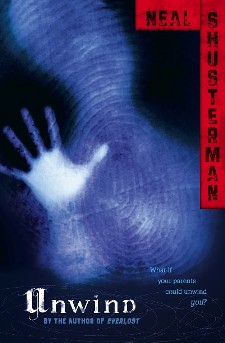
In Unwind by Neal Shusterman, for example, are we more in the action during this scene because it is told in present tense?

A nurse blots swat from his forehead. “Relax, I’m here to help you through this.”
He feels a sharp pinprick in the right side of his neck, and then in the left side.
“What’s that?”
“That,” says the nurse, “is the only pain you’ll be feeling today.”
“That’s it, then,” [he] says. “You’re putting me under?”
Although he can’t see her mouth beneath her surgical mask, he can see the smile in her eyes.

Would you feel differently (see the scene differently) if it was told with “saids” and “saws” instead? Would you have the same visceral reaction to what is going on with this character? Maybe…maybe not. I’m not sure. Perhaps it is up to each reader.

Each of the books I’ve read this week also chose a different point of view.

I’ve struggled with point of view with many of my own projects, and I know a few writers who have started a project in one POV, only to change their minds part way or all the way through, and rewrite the whole work from a different viewpoint.

In Unwind, Mr. Shusterman used alternating third person, sometimes called third person multiple vision. Each chapter was told from a different character’s point of view, focusing mostly on the main three characters, but with some minor ones thrown in for certain pivotal events. After all, things look different depending on who is doing the looking, right?

From a reader’s perspective, I found this constant switching around to be a little distracting. It made me feel a little uncomfortable with the narrative; it was harder to follow than a more traditional third person single perspective or even first person strategy. But again – I now find myself wondering if Mr. Shusterman chose this as a strategy. His story is all about discomfort. His story is about the aftermath of a civil war fought over reproductive rights and the resulting society where abortion is forbidden, but where children can be “unwound” after the age of 13. Discomfort, indeed. (You’ll have to read his book to find out what unwinding involves…no further spoilers here! But trust me – it is uncomfortable, to say the least, to read about it let alone immerse yourself in his dystopia.) So was the flitting back and forth between different views – different perspectives on events unfolding in the story – a conscious decision to transfer the tenuous sense of survival to the reader? Interesting thought, right?

The second novel – one which I haven’t finished yet, but will admit to being completely caught up in despite my initial hesitation – is The Knife of Never Letting Go by Patrick Ness. Also told in present tense, this one is told from first person POV. We learn about the settlement on a planet (not Earth) and the impact of a mysterious disease loosed on the settlers by another alien race. We see this world, society and the unfolding events of the plot through the eyes and voice of the main character, Todd Hewitt.

Told in this POV, we only know what Todd knows. We don’t glimpse any of the knowledge that might be held by other characters – older settlers who witnessed war with the other alien race, for example – until they decide to tell Todd what they know. The history of the settlement prior to Todd being old enough to remember his own life is just as much a mystery to the reader as it is to Todd. For us readers – this leaves us with more of the unknown and maybe  more of a relationship (I think) with our friend, Todd. We are on this ride with him. He is our narrator in a way that characters in third person stories never get to be.

The other benefit of first person (again, in my opinion) is that we hear the main character’s voice throughout the story. Well – I guess that depends on the skill of the writer, doesn’t it? At any rate, told from the “I see..” or “I ran…” or “I heard…” point of view, we hear the Voice of the character with every sentence. It isn’t limited to just dialog, as it is with other story structures.

So what do you think? Conscious decisions to help the dystopia come alive for readers? Or maybe decisions made based on the skill or tendencies of the authors? Either way – I’d say both strategies made for effective storytelling.

I did get out my Gotham Fiction Writers’ Workshop: Writing Fiction, The Practical Guide from New York’s Acclaimed Creative Writing School to see if they had a chapter on POV. Yep. They do. A pretty good one, too, in case you are looking to do a little light reading on craft over your holiday vacation.

Here’s a thought: Take a chapter or scene from a story you love. Pay attention to the POV. Rewrite it from another character’s POV or change the POV altogether. If the author wrote it in first person, you rewrite the events in third. Or vice versa. I did this once as an assignment for a class taught by the talented Lisa Klein, and it was a fantastic, thought-provoking exercise…A step toward making very conscious decisions in your own stories about how the POV will help or hinder your readers as you take them on a journey.

Happy Holidays, everyone! And Happy Writing.