Showing posts with label pov. Show all posts

Tuesday, March 13, 2012

Our Story...Our Point of View

I’m sure you’ve been in a hurry before, driving in heavy traffic, and perhaps been a bit too eager to merge onto the crowded highway. Did you think thoughts like, “Why won’t anyone let me in? Don’t they know I’m late for my meeting/operation/UN Summit?”

I’m also sure you’ve been the schmuck stuck in traffic on the freeway when someone in a hurry tries to merge in front of you… (Although God knows why they don’t SLOW THE HECK DOWN – no meeting/operation/UN Summit could be THAT important!)

See? Same story, different POV.


Today, I was visiting a friend in the hospital. This friend is knowledgeable about medical issues and procedures, therefore had intricate, complex questions for each of the doctors and nurses who came into her room. She was anxious about a specific procedure – involving the insertion of a metal filter into a major vein in her body to prevent blood clots from moving into her lungs or heart. She focused on two examples of negative results she’d found while doing research, and looked for assurance that the suggested procedure was absolutely necessary.  She didn’t want to rush into taking action that was “too invasive” when there might be good odds that she could risk not going through with it.

From my point of view – sitting in the oh-so-comfortable plastic chair in the corner of her hospital room, balancing a Styrofoam cup of room temperature water on my knee and trying not to notice the antiseptic smell wafting through the room – most of these conversations seemed … well … unnecessary, quite frankly. I heard “filter to catch BLOOD CLOTS” and I found myself nodding in agreement. Granted, they weren’t my blood clots…but seriously? Even I know that the words “blood clot” and “heart” shouldn’t every occur in the same sentence, right?

I have no medical background, unless giving birth twice counts. So if someone told me that they could insert a filter to prevent blood clots from moving into my heart – I’d say, “How fast can you put that thing in?” Seriously.

Odds? I’m not a gambler.

Questions about risks? I might ask a few basics, but would be ignorant of many that my friend was clearly concerned about.

Seeking absolutes? I don’t think I would. I think I’d have to trust the medical training and professionalism of the experts around me. My POV doesn’t include experiences and knowledge about veins, blood pressures, thrombosis and embolism. Just not in my vocabulary, really. (I’d still be stuck on clots and heart.)

It was frustrating to sit and listen and try to see things from her POV, when what I wanted to do was grab her by the shoulders, shake her a little, and say, “WHAT IS YOUR PROBLEM, WOMAN? Let them put the darned filter in!!”

On my drive home from the hospital, I found my “writer self” wondering how different all of our stories would be if we could suspend our own POV and see things – really see them – from someone else’s angle.  Like the different drivers in rush hour – or different women in a hospital room -- how often do we each interpret our own story to make ourselves the hero? Or the victim? Or the villain?

There was  a piece aired on my local NPR radio station recently that talked about how Americans tend to  see the world –their own place in it, their stories – differently than many other cultures. We are the driver in a rush – with a good reason to be rushing. But we can also easily re-write the story so that on another day, we become the driver frustrated by others rushing into her lane. We accept both as truth without stopping to see that we have rewritten the same story to have a different meaning based on where we sit within it.

Apparently, we Americans are very attached to our own POV, and make very little attempt to see things from someone else’s POV. So attached, in fact, that we will change the truth of the story to accommodate our different role, depending on the day.

It makes me wonder how my WIPs would differ if I swapped my main character for another in a story. Why did I choose to write my YA novel from the girl’s POV, anyway? Maybe I should try a scene or two from the boy’s point of view – just to see what his truth in the story really is.

Thursday, August 25, 2011

Who do you think I am?

Last Sunday, the sermon at my church was about a time when Jesus asked different people “Who do you say I am?” It wasn’t a Bible story I was very familiar with, but it struck a chord with the storyteller part of me. Jesus didn’t ask, “Who am I?” The question was more subtle and more loaded – it was specific for each person asked. “Who do YOU say I am?”
On the drive home, my mind was busy relating this to fiction and story construction. It made me think about the ever-challenging Point of View aspect of writing. Will you write your story in first person, as if you are speaking for the main character? Or will you rely on limited third person, telling the story from a further distance? Will you see events through their eyes, or will you leap to an omniscient third person point of view and see into all characters thoughts – see events from multiple sets of eyes?
But beyond the POV you’ll choose as a writer for your novel or story, think about this: how do your characters see one another? What are the different points of view within your story?
Take a step back, and let your main character ask his supporting cast, “Who do you say I am?” What kinds of answers will you get? Is your main character fleshed out and well-rounded enough for the others to each have a unique view of him?
I happen to be reading Nancy Farmer’s The House of the Scorpion this week, which is a lucky thing. It is a perfect example of what I’m talking about.
The main character, Matt, grows from a young child to a young adult throughout the story. He is a clone, living in a fictional, futuristic country built on the out of control drug trade along the US-Mexico border. He embodies the outsider. He is both different from everyone around him, while simultaneously being exactly the same.
If Matt pused within his own story and asked, “Who do you say I am?” to characters at various points in the novel, he’d hear answers like:
·         Orphan
·         Child
·         Monster
·         Pet
·         Clone
·         Brother
·         Son
·         Friend
·         Prisoner
·         Promise of youth
·         Livestock
·         Hero
·         Enemy
·         Killer
·         Runaway
·         And student

Nancy Farmer helps readers see her main character through the eyes of others – allowing Matt to have more flesh, more body because the reader can see how others view him.  As the points of view change – as Matt grows in both age and in maturity – the answer to the question shifts.
Are your characters so well developed? Have you considered how your cast of characters sees one another? Could you answer on behalf of your various characters, “Who do you say <name of main character here> is?”
As if point of view, all on its own, wasn’t hard enough to tackle, right? I suppose I’m only now learning there will always be a nuance of writing to discover while driving down the highway or a storytelling skill to learn when you least expect it.
Think of it as a version of “job security” for writers. We’ll never stop learning how to tell a story better, will we?

Friday, December 24, 2010

Things look different depending on who is doing the looking…

Strangely, in this week before Christmas, I’ve been reading a lot about dystopia. (I’m hoping there isn’t a connection there, but who knows? The coming of Christ…a whole new world… hmmmm.)

Of the two different dystopian worlds I’ve read about in the last week or so, I’ve been sort of fascinated with two choices these writers had made: verb tense and point of view.

 It struck me that both writers used present tense throughout their stories. Just interesting, isn’t it? They chose to use present tense to describe a futuristic, post-apocalyptic world. I wondered if that was consciously influenced by their plot and subject matter. Is it best to speak about a created world – one that supposedly results from our own culture and society -- as if it is happening right now? Will readers invest themselves more readily in these worlds of despair and struggle? (Because, if you haven’t read much dystopian fiction lately, it is ALWAYS a world of despair and struggle.)

I haven’t taken the time to look at more adult fiction of this vein to see if those writers, too, present their stories in present tense… But I have Cronin’s The Passage on a shelf upstairs. I should look…

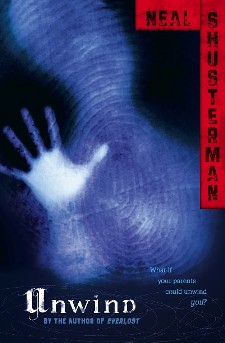
In Unwind by Neal Shusterman, for example, are we more in the action during this scene because it is told in present tense?

A nurse blots swat from his forehead. “Relax, I’m here to help you through this.”
He feels a sharp pinprick in the right side of his neck, and then in the left side.
“What’s that?”
“That,” says the nurse, “is the only pain you’ll be feeling today.”
“That’s it, then,” [he] says. “You’re putting me under?”
Although he can’t see her mouth beneath her surgical mask, he can see the smile in her eyes.

Would you feel differently (see the scene differently) if it was told with “saids” and “saws” instead? Would you have the same visceral reaction to what is going on with this character? Maybe…maybe not. I’m not sure. Perhaps it is up to each reader.

Each of the books I’ve read this week also chose a different point of view.

I’ve struggled with point of view with many of my own projects, and I know a few writers who have started a project in one POV, only to change their minds part way or all the way through, and rewrite the whole work from a different viewpoint.

In Unwind, Mr. Shusterman used alternating third person, sometimes called third person multiple vision. Each chapter was told from a different character’s point of view, focusing mostly on the main three characters, but with some minor ones thrown in for certain pivotal events. After all, things look different depending on who is doing the looking, right?

From a reader’s perspective, I found this constant switching around to be a little distracting. It made me feel a little uncomfortable with the narrative; it was harder to follow than a more traditional third person single perspective or even first person strategy. But again – I now find myself wondering if Mr. Shusterman chose this as a strategy. His story is all about discomfort. His story is about the aftermath of a civil war fought over reproductive rights and the resulting society where abortion is forbidden, but where children can be “unwound” after the age of 13. Discomfort, indeed. (You’ll have to read his book to find out what unwinding involves…no further spoilers here! But trust me – it is uncomfortable, to say the least, to read about it let alone immerse yourself in his dystopia.) So was the flitting back and forth between different views – different perspectives on events unfolding in the story – a conscious decision to transfer the tenuous sense of survival to the reader? Interesting thought, right?

The second novel – one which I haven’t finished yet, but will admit to being completely caught up in despite my initial hesitation – is The Knife of Never Letting Go by Patrick Ness. Also told in present tense, this one is told from first person POV. We learn about the settlement on a planet (not Earth) and the impact of a mysterious disease loosed on the settlers by another alien race. We see this world, society and the unfolding events of the plot through the eyes and voice of the main character, Todd Hewitt.

Told in this POV, we only know what Todd knows. We don’t glimpse any of the knowledge that might be held by other characters – older settlers who witnessed war with the other alien race, for example – until they decide to tell Todd what they know. The history of the settlement prior to Todd being old enough to remember his own life is just as much a mystery to the reader as it is to Todd. For us readers – this leaves us with more of the unknown and maybe  more of a relationship (I think) with our friend, Todd. We are on this ride with him. He is our narrator in a way that characters in third person stories never get to be.

The other benefit of first person (again, in my opinion) is that we hear the main character’s voice throughout the story. Well – I guess that depends on the skill of the writer, doesn’t it? At any rate, told from the “I see..” or “I ran…” or “I heard…” point of view, we hear the Voice of the character with every sentence. It isn’t limited to just dialog, as it is with other story structures.

So what do you think? Conscious decisions to help the dystopia come alive for readers? Or maybe decisions made based on the skill or tendencies of the authors? Either way – I’d say both strategies made for effective storytelling.

I did get out my Gotham Fiction Writers’ Workshop: Writing Fiction, The Practical Guide from New York’s Acclaimed Creative Writing School to see if they had a chapter on POV. Yep. They do. A pretty good one, too, in case you are looking to do a little light reading on craft over your holiday vacation.

Here’s a thought: Take a chapter or scene from a story you love. Pay attention to the POV. Rewrite it from another character’s POV or change the POV altogether. If the author wrote it in first person, you rewrite the events in third. Or vice versa. I did this once as an assignment for a class taught by the talented Lisa Klein, and it was a fantastic, thought-provoking exercise…A step toward making very conscious decisions in your own stories about how the POV will help or hinder your readers as you take them on a journey.

Happy Holidays, everyone! And Happy Writing.